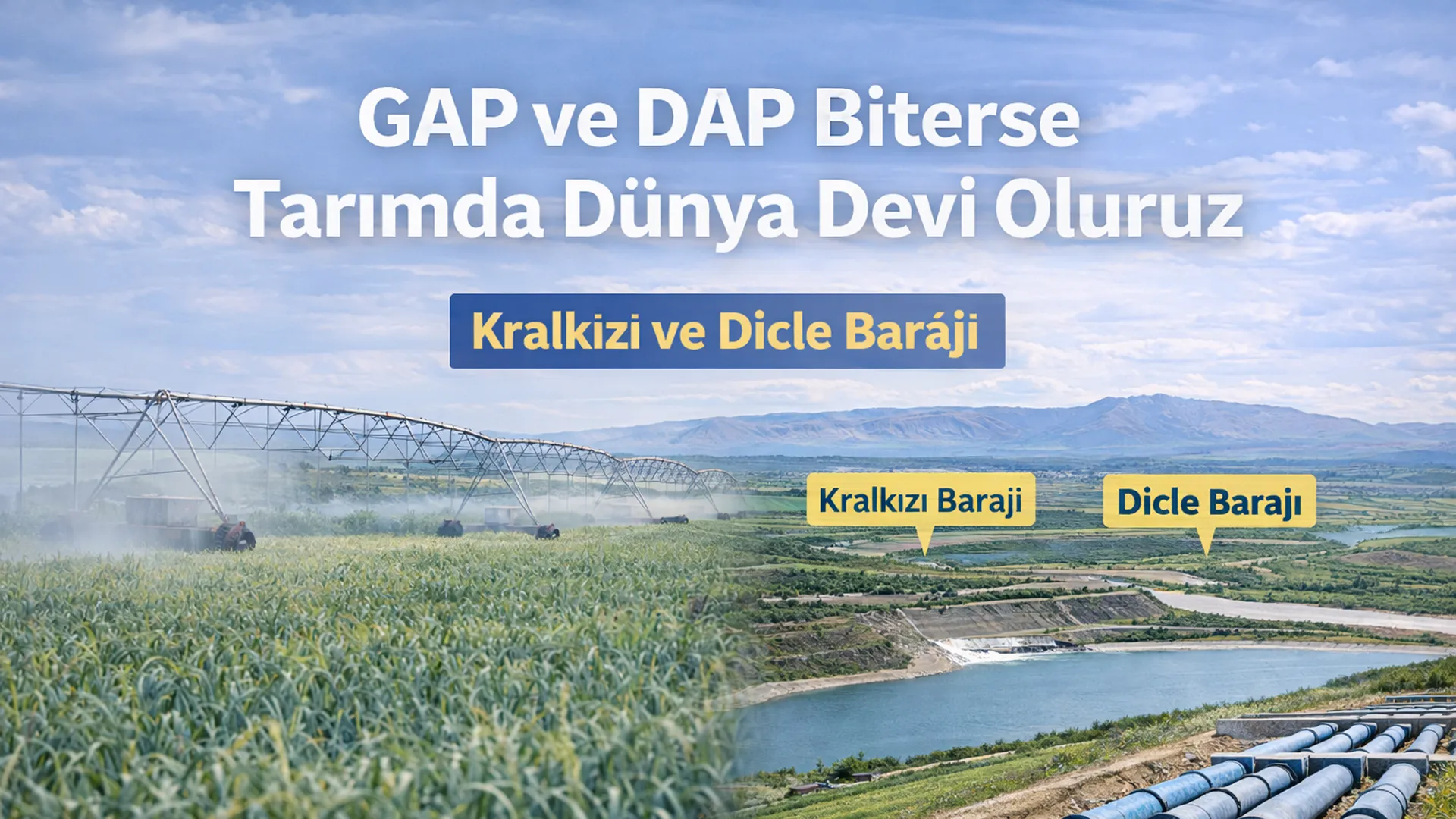
Completing GAP and DAP Will Make Turkey a Global Agricultural Power
September 20, 2022GAP and DAP Irrigation Investments
Selin Canakci, Vice Chairman of the Board of Best Tasarim Insaat, stated that Turkey could achieve a globally powerful position in agriculture if the irrigation investments within the scope of the Southeastern Anatolia Project (GAP) and the Eastern Anatolia Project (DAP) are realized.
Canakci noted that within the scope of GAP, 130,000 hectares were planned to be opened for irrigation, but despite approximately 20 years having passed, only 20,000 hectares of this area had been brought into irrigation. She emphasized that 110,000 hectares still urgently need to be opened for irrigation.
Canakci pointed out that although Kralkizi Dam and Dicle Dam have been operational since 1997, irrigation targets have not been met. She stated that while the economic lifespan of dams is approximately 50 years, their waters have not been effectively utilized for roughly 25 years. She noted that 222 kilometers of main irrigation canals were constructed in previous years to enable irrigation from the dams; however, due to the prolonged absence of water supply, their physical structures have deteriorated. Canakci stated that the first delivery of water to the main canals in 2021 generated great excitement in the region and that, as of this year, greater importance has begun to be given to the projects.
Drought and Agricultural Crisis Pose a Serious Threat
Drawing attention to the global drought crisis, Selin Canakci stated that accelerating agricultural production is no longer a choice but a necessity. Emphasizing that planting only wheat and barley on Turkey's fertile yet idle agricultural lands is insufficient, Canakci stressed the need to support alternative, high-value-added crops.
Canakci noted that the areas to be opened for irrigation will not only contribute to the economy but also help prevent migration and social issues. She stated that with the transition to irrigated agriculture, many ancillary sectors such as fertilization, pesticide application, packaging, logistics, and agricultural machinery will be directly affected, providing significant contributions to the national economy.
Agriculture Directly Impacts Inflation
Stating that agriculture is the fundamental pillar of industry, Canakci expressed that developed countries have strengthened their industries through agriculture. Recalling that countries such as the United Kingdom, France, Germany, the Netherlands, and Sweden have successfully implemented this model, Canakci said that Turkey possesses similar potential.
Emphasizing that Turkey has the capacity to serve as a breadbasket given its geographical and geopolitical position, Canakci noted that the Arabian Peninsula and African countries have significant grain needs, yet this advantage has not been sufficiently leveraged. Stating that price fluctuations in agricultural products trigger inflation, Canakci said that increasing agricultural production and reducing costs play a key role in combating inflation.
Sustainability Cannot Be Achieved Without Farmer Education
Selin Canakci stated that Provincial Directorates of Agriculture and Forestry bear significant responsibilities in educating farmers, emphasizing the need to encourage cooperativization and increase crop diversity suitable for the region. She expressed that provincial directorates should guide farmers by considering climate and soil conditions, and that irrigation should not be limited solely to cereals but should also extend to fruit and vegetable cultivation.
Agricultural Lands Must Not Be Opened for Urban Development
Stating that opening agricultural lands for urban development is one of Turkey's biggest problems, Canakci expressed that converting fertile agricultural soils into residential and industrial areas causes great long-term damage to the national economy. Emphasizing that production must be carried out on lands suitable for agriculture, Canakci added that it would be a more appropriate policy to provide agricultural subsidies based on actual production rather than land size.


